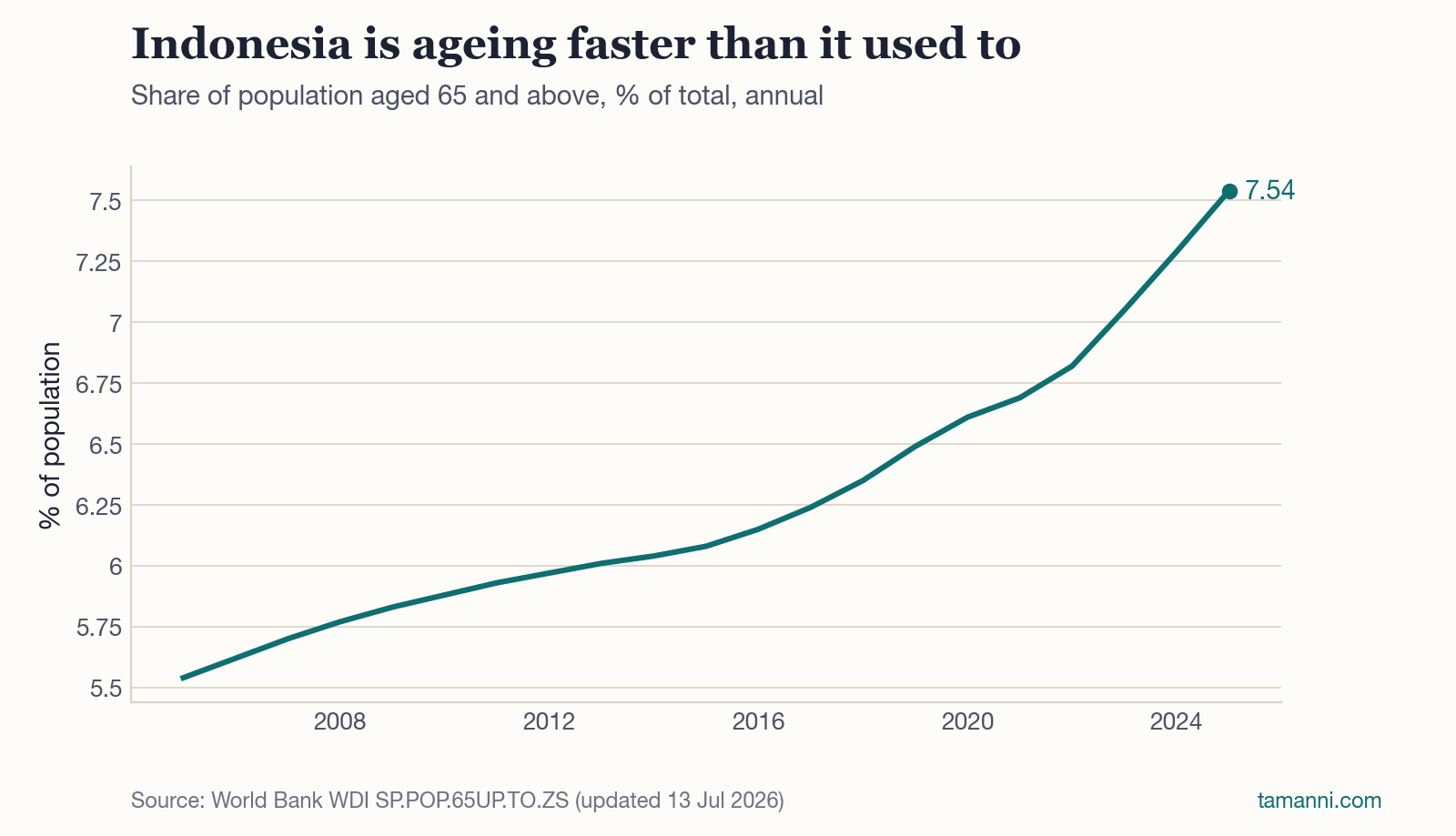
What happened. People aged 65 and above were 7.54% of Indonesia’s population in 2025, up from 6.08% in 2015 and 5.54% in 2005.1 Those above 60, which is a more conservative measure of ageing society, constitutes an even greater percentage i.e. about 12% in 2025 according to BPS. By our estimates, the share of older people rose about 0.5 percentage points in the first decade (2005 to 2015), and about 1.5 points in the second (2015-2025). It is almost three times faster!
Why it matters. A larger share of older people means more households with parents who no longer earn, and fewer working-age relatives to support each of them. Many Indonesian families already carry this through the so-called sandwich generation: adults who support both their children and their parents. The figures are demographic estimates compiled by the World Bank, not a count of retirees, and 65 is only a convention used by the World Bank to compare Indonesia with other countries.
What it means for ordinary Indonesians
– Households: a parent’s long-term care and living costs may arrive while children’s school fees are still running. It helps to talk about it with siblings early, before an ageing crisis forces the conversation.
– Business owners: an ageing workforce and founder generation make succession and retirement benefits a planning necessity, not just an HR formality.
– Worth watching: the next World Bank update of this series, and the national census data from BPS.
This article is for general information and education only. It is not investment, tax, legal or Sharia finance advice and does not consider your personal circumstances. Please consult a qualified adviser before making financial decisions.
- World Bank, World Development Indicators, “Population ages 65 and above (% of total population)”, SP.POP.65UP.TO.ZS, Indonesia, last updated 13 Jul 2026, retrieved 8 Oct 2026. https://api.worldbank.org/v2/country/IDN/indicator/SP.POP.65UP.TO.ZS ↩
Editor’s note: This article was drafted with AI research assistance, before I began writing every article myself. Sources are cited above.
