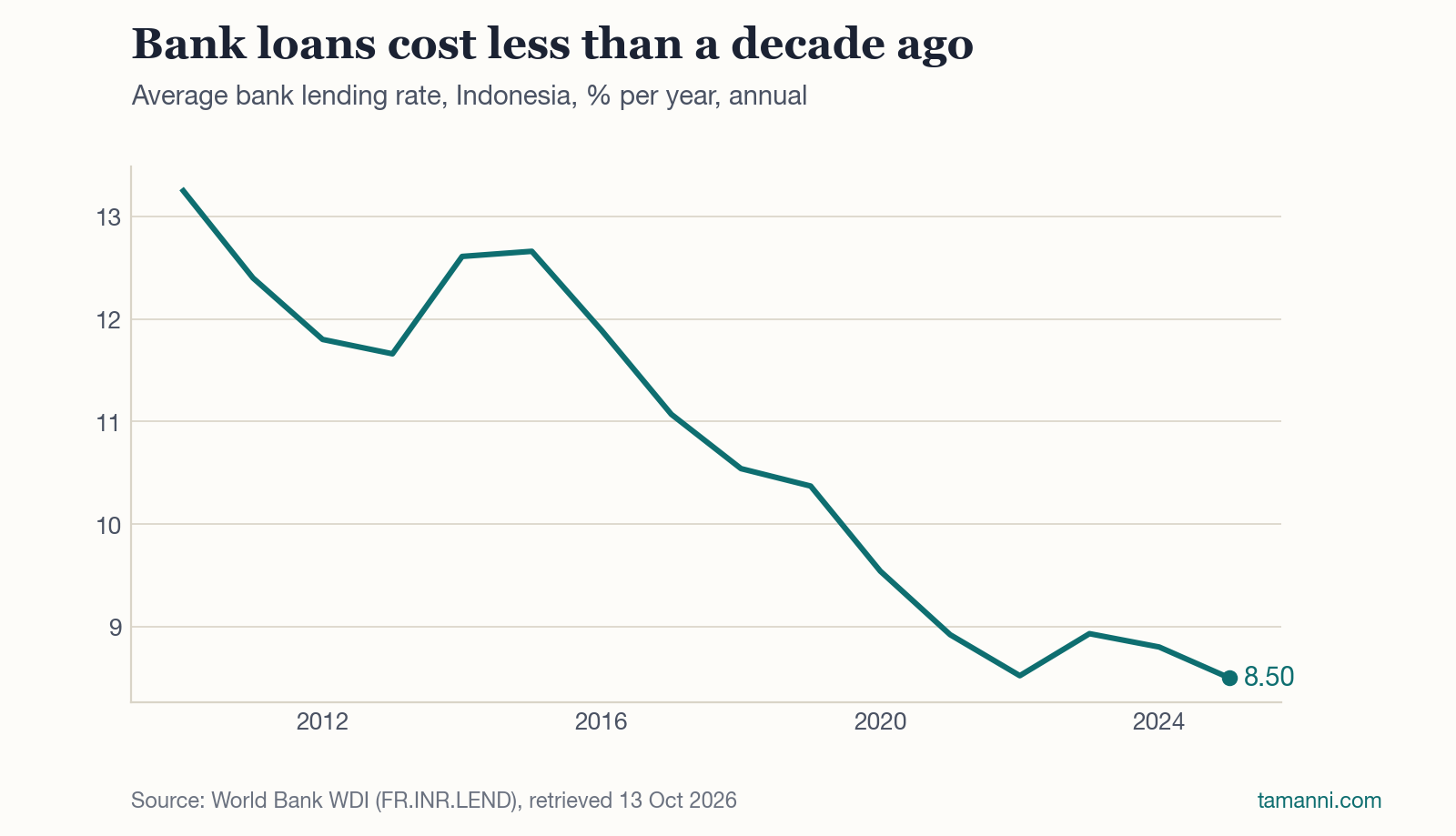
What happened. The average rate banks charge borrowers in Indonesia was 12.66% in 2015 and down to 8.50% in 2025, a fall of about 4.2 percentage points.1 The decline was steady from 2015 to 2022, with a pause in 2023, and then up again to 8.93%. Currently rates are steady at single digit across many of the commercial loan products.
Why it matters. A lending rate is the yearly price of borrowed money, quoted as a percentage of the loan. For a Rp500 million loan, annual interest of 12.66% will rack up Rp63 million; whilst a 8.50% rate, will set back borrowers by Rp42 million. The gap of roughly Rp21 million a year is quite significant for borrowers. This is a national average across loan types. While this is mostly about industry wide rates, sharia financing is priced somewhat differently with margins or profit-sharing mechanism.
What it means for you
– Households: cheaper credit/financing lowers the carrying cost of a home or vehicle purchase, but it does not change the total owed to banks.
– Business owners: lower average borrowing costs ease working-capital and expansion financing, though banks still price each borrower separately.
– Worth watching: the 2026 figure, which the World Bank has not yet published.
This article is for general information and education only. It is not investment, tax, legal or Sharia advice and does not consider your personal circumstances. Please consult a qualified adviser before making financial decisions.
- World Bank, World Development Indicators, FR.INR.LEND “Lending interest rate (%)”, Indonesia, last updated 8 Oct 2026, retrieved 13 Oct 2026. https://api.worldbank.org/v2/country/IDN/indicator/FR.INR.LEND ↩
Editor’s note: This article was drafted with AI research assistance, before I began writing every article myself. Sources are cited above.
