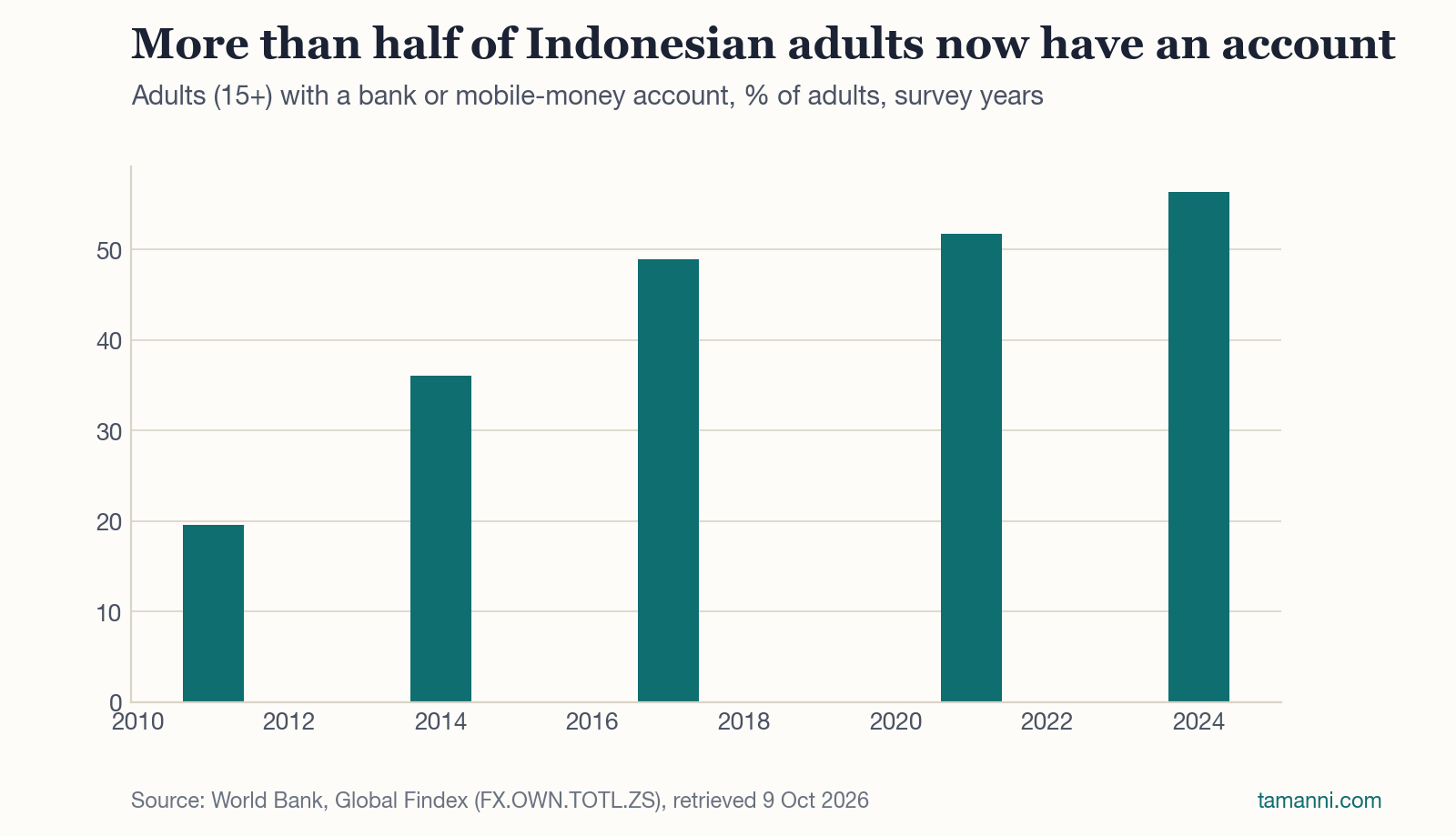
What happened. In 2024, 56.3% of Indonesian adults had an account at a financial institution or with a mobile-money provider. In 2011 the figure was 19.6%. Most of the gain came early: the share rose about 29 points between 2011 and 2017, but only about 7.5 points between 2017 and 2024.1
Why it matters. The numbers come from the Global Findex, a survey held every few years, so the chart has five points rather than one for each year. An account is the starting point for almost everything else: saving, receiving a salary or family remittance, paying school fees, or buying takaful. The slower recent pace suggests the easy gains are done. The remaining 44% of adults are harder to reach. The survey cannot tell us how actively the accounts are used, or whether people also keep cash at home.
What it means for you
– Households: if you support relatives who are outside the formal system, an account in their own name can make regular transfers cheaper and easier to track than cash.
– Business owners: more adults with accounts widens the market for digital payments and savings products, but the next customers are likely to be lower-income and more rural.
– Worth watching: the next Global Findex round, which is usually released every three years.
This article is for general information and education only. It is not investment, tax, legal or Sharia advice and does not consider your personal circumstances. Please consult a qualified adviser before making financial decisions.
-
World Bank, World Development Indicators / Global Findex, “Account ownership at a financial institution or with a mobile-money-service provider (% of population ages 15+)”, Indonesia (FX.OWN.TOTL.ZS), dataset last updated 8 Oct 2026, retrieved 9 Oct 2026. https://api.worldbank.org/v2/country/IDN/indicator/FX.OWN.TOTL.ZS. Values for 2011, 2014, 2017, 2021 and 2024 only; no other years are available and none are estimated. ↩
Editor’s note: This article was drafted with AI research assistance, before I began writing every article myself. Sources are cited above.
