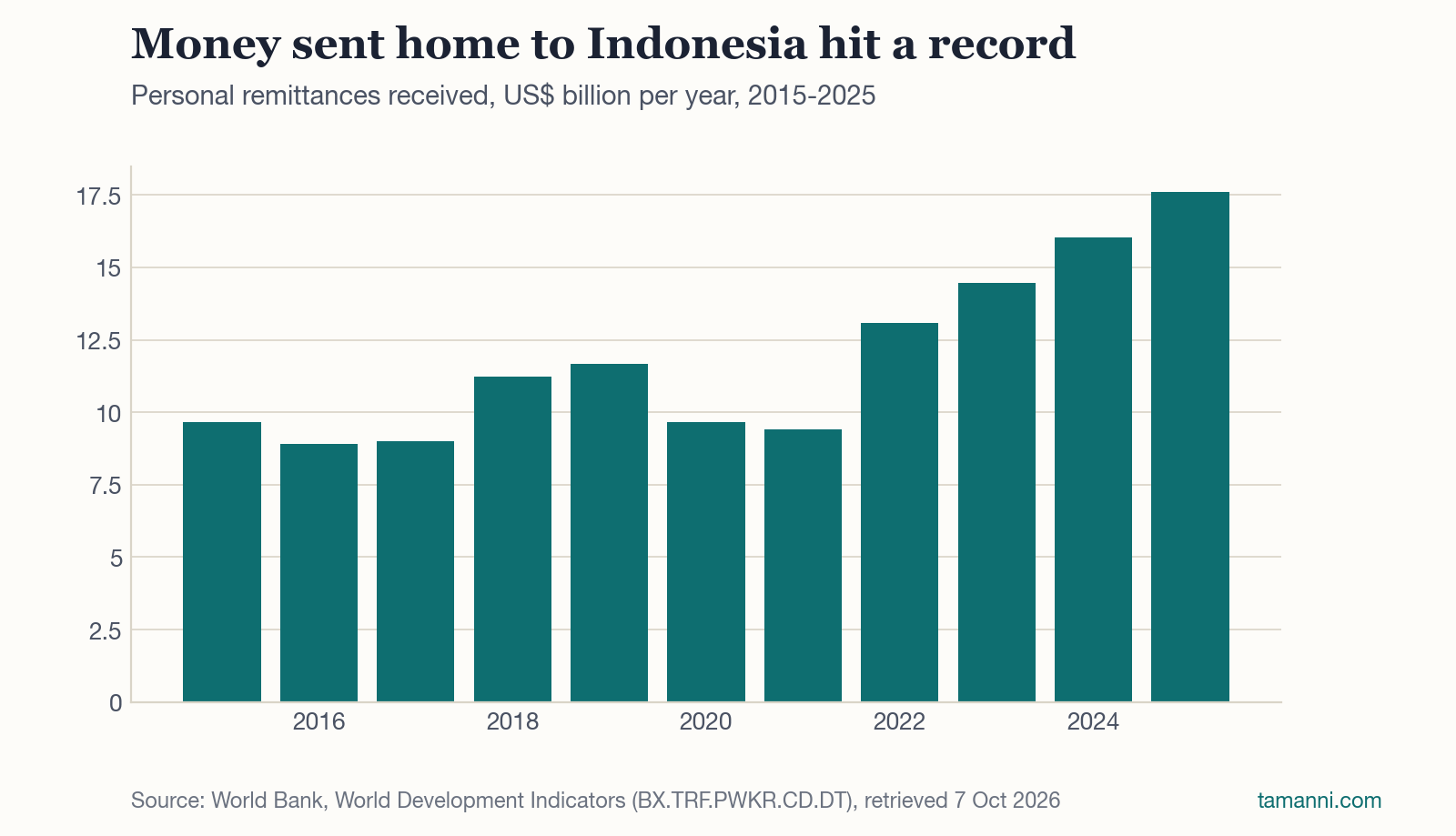
What happened. Indonesians working abroad (the rupiah heroes) and other senders moved US$17.6 billion to Indonesia in 2025. That was the highest figure in the series, which starts in 2005. It compares with US$9.4 billion in 2021, a rise of about 87% (our own calculation from the rounded series). The jump came in 2022, when the total rose about 39% in one year, and it has risen every year since.1
Why it matters. “Remittances” means money that workers abroad send to family at home. The World Bank series counts these personal transfers plus the pay of workers abroad. It is measured in US dollars, so part of any change in rupiah terms depends on the exchange rate. The data cannot tell us how families use the money. It also cannot show how much travels through informal channels, which official statistics may miss. Still, the direction is clear: more money is arriving from abroad than at any point in the past twenty years.
What it means for you
– Households: if you send or receive family support, the cost and speed of each transfer channel are worth comparing, because fees come straight off the amount that arrives. Regular, planned transfers are easier to budget around than occasional ones.
– Business owners: rising inflows support household spending, which matters for retail, property and education services.
– Worth watching: the 2026 figure, which the World Bank will publish next year, and whether the rise holds if the rupiah moves sharply.
This article is for general information and education only. It is not investment, tax, legal or Sharia advice and does not consider your personal circumstances. Please consult a qualified adviser before making financial decisions.
- World Bank, World Development Indicators, “Personal remittances, received (current US$)”, Indonesia (BX.TRF.PWKR.CD.DT), dataset last updated 13 Jul 2026, retrieved 7 Oct 2026. https://api.worldbank.org/v2/country/IDN/indicator/BX.TRF.PWKR.CD.DT. Annual values, rounded to two decimals in US$ billions in our chart file. The series is compiled from balance-of-payments data; we did not verify the underlying compilation. ↩
Editor’s note: This article was drafted with AI research assistance, before I began writing every article myself. Sources are cited above.
