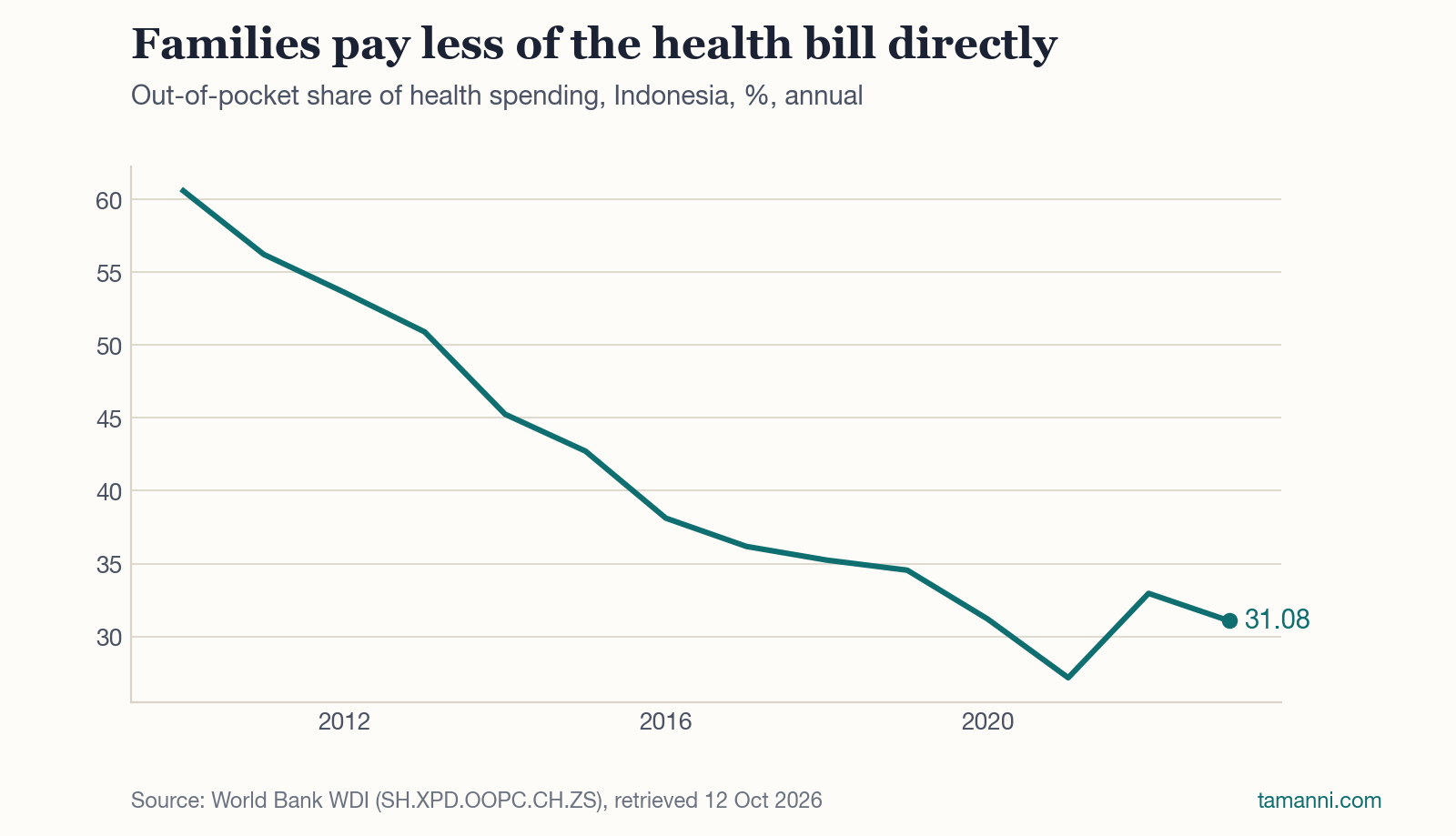
What happened. In 2010, Indonesian households paid 60.6% of their health spending directly, at the clinic, pharmacy or hospital counter. By 2023, the latest year available, that share down to 31.1%, a fall of nearly 30 percentage points.1 The decline was not straightforward i.e. down to 27.2% in 2021 and then rose to 33.0% in 2022, before easing again. However, the overall effect is a great relieve for many families.
Why it matters. “Out-of-pocket” means money paid by the patient at the time of care, rather than through public insurance or private cover. A falling share means more of the bill is carried by BPJS Kesehatan and private insurers. Since the data covers the whole population, it tells little about what is the most common treatment Indonesian families are seeking.
What it means for you
– Households: a health bill is still partly a cash-flow event, so many families keep a dedicated emergency fund alongside any national/BPJS or private insurance cover.
– Business owners: employee health benefits shape staff costs and retention; the out-of-pocket share shows how much risk still sits with employees.
– Worth watching: the 2025 figure, which the World Bank has not yet published.
This article is for general information and education only. It is not investment, tax, legal or Sharia advice and does not consider your personal circumstances. Please consult a qualified adviser before making financial decisions.
- World Bank, World Development Indicators, SH.XPD.OOPC.CH.ZS “Out-of-pocket expenditure (% of current health expenditure)”, Indonesia, last updated 8 Oct 2026, retrieved 12 Oct 2026. https://api.worldbank.org/v2/country/IDN/indicator/SH.XPD.OOPC.CH.ZS ↩
Editor’s note: This article was drafted with AI research assistance, before I began writing every article myself. Sources are cited above.
